

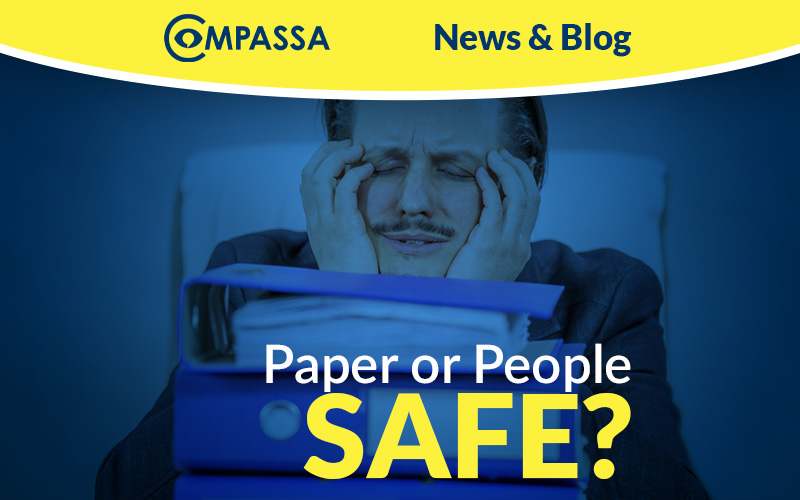
Is Your Company ‘Paper-Safe’ or Actually ‘People-Safe’?
Walk into almost any modern business in the UK, ask to see their Health and Safety documentation, and you will likely be handed a pristine, heavily branded binder. Inside, you will find beautifully formatted risk assessments, comprehensive corporate safety policies signed by the CEO, and meticulously filed training registers.
On paper, the company looks impenetrable. If an external auditor or an insurance representative walks into the boardroom to review the documentation, the company passes with flying colours.
But walk out of the office and onto the shop floor, the warehouse, or the construction site, and an entirely different story unfolds. You see workers bypassing machine guards to speed up production. You see trailing cables ignored because “someone else will pick it up.” You see supervisors turning a blind eye to missing Personal Protective Equipment (PPE) because they are under immense pressure to hit their Friday afternoon shipping targets.
This is the dangerous, pervasive illusion of being “Paper Safe.”
The Illusion of Compliance
A paper safe company treats Health and Safety as a purely administrative exercise. The ultimate goal is not necessarily to prevent harm; the goal is to prevent liability. In these environments, the Health and Safety Manager is often reduced to an administrator, spending 90% of their time chasing signatures, updating Excel spreadsheets, and filing forms, rather than observing behaviours and talking to the workforce.
The primary danger of the paper safe illusion is that it breeds a false sense of security at the executive level. Company directors look at the monthly audit reports, see 100% compliance on the paperwork, and assume the workforce is protected.
But a signed piece of paper has never stopped a falling pallet. A perfect risk assessment locked in a filing cabinet does not prevent a slip on a wet floor.
Under the Health and Safety at Work etc. Act 1974, the Health and Safety Executive (HSE) does not just look for the mere existence of paperwork, they look for its practical implementation. If a serious accident occurs and investigators discover that your written procedures were routinely ignored on the shop floor, your paperwork will be used as evidence against you. It proves that you were fully aware of the hazards and the necessary control measures, but you systematically failed to enforce them. In the eyes of the law, a paper safe culture is a negligent culture.
The True Cost of a Paper Safe Culture
Operating in a paper safe bubble is a massive financial risk. When the focus is on ticking boxes rather than altering behaviours, accidents are inevitable.
When an incident occurs, the hidden costs rapidly compound. Beyond the tragic human cost of a workplace injury, the business faces:
- HSE Intervention: Under the Fee for Intervention (FFI) scheme, if the HSE finds a material breach of health and safety law, they will charge you for the time they spend investigating it.
- Lost Productivity: Downtime during investigations, lowered staff morale, and the absence of key personnel.
- Insurance Hikes: Premiums skyrocket following a major claim or prosecution.
- Reputational Damage: Clients and contractors are increasingly refusing to work with businesses that have poor safety records.
What is a ‘People Safe’ Culture?
A “People Safe” organisation fundamentally understands that safety is a behaviour, not a document. In a people safe culture, the paperwork accurately reflects reality, but it is the culture itself that drives the safety.
Key indicators of a people safe culture include:
- True Empowerment: Workers feel completely empowered to stop a job or halt a production line if they feel it is unsafe, without any fear of reprimand from management.
- Enthusiastic Reporting: Near misses are reported constantly, not hidden. The workforce knows management will use the data to fix systemic problems, not punish individuals.
- Safety over Speed: When production targets clash with safety procedures, safety always wins.
The Missing Link: The Line Manager
How do you transition your business from paper safe to people safe? The answer lies almost entirely with your line managers and supervisors.
You can have the best Health and Safety Manager in the world, but they cannot be everywhere at once. The line manager sets the culture for their specific team. If a supervisor implies through their words or their actions that hitting a target is more important than following the risk assessment, the team will ignore the paperwork.
You cannot fix a broken supervisory culture with another risk assessment template. You fix it by training your leaders.
Bridging the Gap with IOSH Managing Safely
Your supervisors need to understand the legal and moral reasons behind the rules in the binder. They need to understand that they, personally, hold a duty of care, and that turning a blind eye leaves them legally exposed.
This is exactly what the IOSH Managing Safely qualification is designed to do. It is the global standard for transforming non safety professionals into accountable safety leaders. It teaches managers why the rules exist, how to conduct practical, dynamic risk assessments, and how to take legal ownership of their team’s safety.
However, how you deliver this training matters. If you pull a stressed supervisor off the floor and lock them in a classroom for three days to read bullet points off a PowerPoint presentation, they will tune out. They will treat the training as just another administrative tick box exercise.
At Compassa, we have rebuilt the IOSH Managing Safely course for the modern workforce. Our platform is 100% digital, replacing boring slides with interactive video simulators. Your managers are placed in virtual, high stakes scenarios where they must practice making real time safety decisions. They see the consequences of poor leadership play out on screen, ensuring they actually retain the knowledge needed to keep your business legally compliant and your people safe.
Stop hiding behind the binder. Let’s start building a culture where safety is a mindset, not a signature. Enrol your leadership team in Compassa’s interactive IOSH Managing Safely course today.

Leave a Reply